
Skip to content

Architecture to execution

SAP Enterprise
Architecture

From transformation strategy to governed architecture execution.

Designing target and transition architectures for heterogeneous SAP and non-SAP environments, with decisions grounded in business context, technology constraints and delivery governance.

Explore the approach
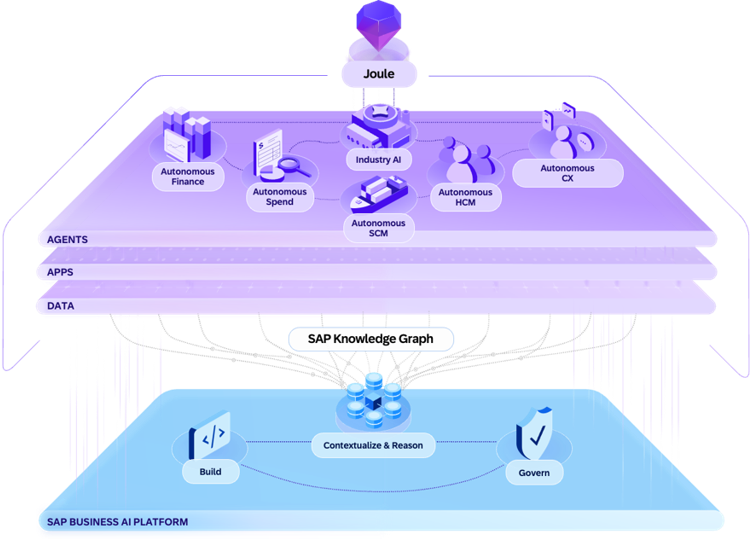
SAP technology ecosystem with Joule above agents, applications and data, connected through SAP Knowledge Graph to build and governance capabilities.
SAP Autonomous Enterprise · Technology ecosystem reference · Source:SAP

The Architecture Challenge

Complex transformations demand
more than a target landscape.

The architecture has to hold together across business units, platforms and delivery teams, including the periods when old and new systems operate side by side.

Fragmented decisions

Local choices can create enterprise-wide dependencies or competing process and data owners.

Landscape complexity

End-to-end processes cross multiple systems, each with its own release cycle and responsibilities.

Technology constraints

Existing investments, entitlements and operating capacity shape which options are viable.

Execution disconnect

Implementation choices can drift from the target when decision rights and review points are unclear.

What my architecture logic considers

Business outcomes and operating constraints shape the options. I compare the trade-offs across these four dimensions before committing to a technology or a transition path.

Business & transformation

  • Business capabilitiesWhich capabilities need to change, and who owns them?
  • Transformation driversWhich outcomes justify the change?

Technology & interoperability

  • SAP & non-SAP landscapeWhere should capability and system boundaries sit?
  • Data & integrationWho owns each data object and interaction contract?

Governance & operations

  • Identity & securityHow do trust boundaries and access controls carry across systems?
  • Operating responsibilitiesWho runs, monitors and restores the service?

Decision & evolution

  • Architecture decisionsWhich options were considered, and when should we revisit the choice?
  • Assurance & transitionWhat must each interim state prove before the next wave?

From Strategy to Architecture Execution

Five moments connect transformation intent to delivery. The depth of each depends on the program’s complexity and risk.

  1. Assess

    Map drivers, capability owners and the existing landscape.

  2. Frame

    Define boundaries and compare feasible target and transition options.

  3. Decide

    Agree on criteria, select a path and record accepted trade-offs.

  4. Govern

    Assign decision rights, define exceptions and set review gates.

  5. Assure

    Check design and readiness evidence as each wave progresses.

Architecture Scenario Explorer

Different contexts. Different architecture decisions.

Select a transformation scenario to see which criteria, trade-offs and governance decisions matter most.

Consolidation-led Transformation

Architecture challenge
Several ERP instances support overlapping capabilities. Can a common core standardize the right processes while protecting business continuity?

Relevant decision criteria
Compare process fit, statutory variations, master data quality, tolerated downtime and the capacity to migrate by wave.
Principal trade-offs
A shared template lowers fragmentation but couples releases and concentrates cutover risk. Staged migration reduces disruption per wave and extends coexistence.
Architecture implications
Define where variations are permitted, who owns master data in each interim state and which units can migrate together.
Governance considerations
Give template exceptions an owner and review date. Require reconciliation, readiness and fallback evidence before each cutover.

Distributed SAP Landscape

Architecture challenge
Multiple SAP environments serve distinct operating boundaries. A single business process can still cross those boundaries and create shared dependencies.

Relevant decision criteria
Compare legal and operating autonomy, transaction ownership, cross-system volumes, required data consistency and independent release cycles.
Principal trade-offs
Local autonomy preserves fit and release flexibility. Shared process and data contracts reduce ambiguity but require coordination across teams.
Architecture implications
Assign system-of-record and posting responsibilities, define failure recovery and plan the dependency order for changes across environments.
Governance considerations
Name the end-to-end process owner and the contract owners. Coordinate versioning, monitoring and joint acceptance of critical flows.

Hybrid Enterprise Modernization

Architecture challenge
SAP modernizes core transactions while established non-SAP platforms continue serving other enterprise capabilities.

Relevant decision criteria
Compare capability fit, sunk and future costs, lifecycle and entitlement constraints, supported interfaces and the capacity to operate multiple platforms.
Principal trade-offs
Reuse protects existing investments and can accelerate delivery. Introducing a new platform can improve local fit and add integration and support burden.
Architecture implications
Assign platform and data responsibilities before choosing connectors. Use stable contracts and intermediate states to replace components progressively.
Governance considerations
Define which decisions sit with enterprise or domain owners. Review platform exceptions, operational hand-offs and the retirement of temporary contracts.

Architecture Deliverables

Each deliverable answers a decision the program needs to make, from defining the target landscape to reviewing a bounded solution design.

Architecture Decision & Governance Framework

Make architecture choices traceable and give exceptions an owner and a review point.

What it is
An approach to recording options, decision rationale, responsibilities and conditions for revisiting a choice.
Why it matters
A decision can lose its original context as workstreams implement it or as licensing, timing and operating assumptions change.
What it enables
Link drivers and design decisions to accountable owners, review gates, exceptions and the evidence needed to close them.
How it adapts
Use lightweight records for bounded changes and more formal escalation and assurance for choices with enterprise-wide consequences.

Solution Architecture Design Framework

Translate enterprise decisions into a bounded design teams can implement and review.

What it is
A solution-design approach illustrated by the Solution Architecture Design Document (SADD) project template.
Why it matters
A workstream may inherit a platform rule or integration posture without carrying it through to implementation and acceptance.
What it enables
Trace requirements to components, data and interface contracts, measurable non-functional requirements and acceptance evidence.
How it adapts
Scale design depth by complexity and risk, with explicit ownership, security and supported contracts across all tiers.

Architecture in Practice

Illustrative examples of how the approach applies to recurring architecture problems.

Multiple SAP Environments

When an end-to-end process crosses SAP environments, map transaction ownership and the hand-offs first. This lets teams decide which system posts, which consumes and who restores failed exchanges.

Hybrid SAP / Non-SAP Landscapes

When enterprise platforms already serve multiple domains, map their responsibilities against SAP capabilities. Use that map to decide which platforms to retain and where interface or data ownership must change.

Phased Transformation

When deployments run in waves, give each interim state its own data authority, reconciliation controls and exit criteria. This gives governance a basis for approving the next cutover and retiring temporary interfaces.